Saffron FAQ — How to Buy, Use, Store & Verify Real Saffron
The Saffron FAQ · Answered from the source
Every saffron question, answered honestly
Twenty-two questions home cooks, gift-givers, and tea drinkers ask us most — on buying, using, grading, and verifying real saffron. Answered by the family that has traded Herat saffron since 1996, with lab numbers instead of adjectives. Each answer links to a deeper guide in our Learn library when you want to go further.
- 01 Buying & authenticity
- 02 Using & cooking
- 03 Grades & lab testing
- 04 Shipping, returns & the company
Buying & authenticity
Six questions · before any money changes hands
1.1How do I tell if my saffron is real?
Start with the water test. Drop a few threads into a cup of cool water: real saffron releases its gold slowly, over ten to fifteen minutes, and the threads stay deep crimson the whole time. Dyed fakes bleed color almost instantly, and the threads themselves turn pale as the dye leaves them. Back it up with the rub test (real threads stain your fingers gold-orange, not red) and the smell test — honey and fresh hay, never sweet perfume.
We keep a full field manual of at-home tests in How to Spot Fake Saffron, and an interactive version at Is Your Saffron Real? that walks you through a verdict in about a minute.
1.2Why is saffron so expensive?
Because there is no machine for it. Each Crocus sativus flower yields exactly three stigmas, picked by hand at dawn during a harvest window of roughly two weeks a year. It takes about 150 flowers to produce a single gram of dried threads — every gram passes through human hands several times for picking, separating, drying, and sorting. That labor, not marketing, is the price floor. Our 2026 saffron price guide breaks down what a fair price per gram actually looks like.
1.3What should real saffron cost?
Genuine saffron is difficult to produce for much under ~$7 per gram at retail once harvest labor, export, and packaging are paid. So when you see "1 oz of saffron" (about 28 grams) for $30, the math says roughly a dollar a gram — that product is either dyed safflower, exhausted low-grade threads, or worse. Our ladder runs from 1 g at $20 to 10 g at $99 ($9.90 per gram) — honest pricing for threads that are ISO 3632 Category I on the tested parameters (lab report 004389), with no discount theater.
1.4What's the best saffron brand in the USA?
The honest answer: the best choice is whichever brand shows you its numbers. Judge any label — including ours — on four things: a published ISO 3632 lab result (Category I or it's ordinary), a stated harvest year, a named origin region, and thread grade. Brands that hide all four are asking you to buy adjectives. We compared the major labels sold in America, ourselves included, in The Best Saffron Brands in the USA.
1.5Does origin matter — Afghan vs. Iranian vs. Spanish vs. Kashmiri?
Less than the labels suggest. Iran grows the most; Afghanistan — especially the high-desert Herat highlands we source from — is known for long, deep-crimson Super Negin threads; Spain markets brilliantly; Kashmir is rare and prized. But grade beats origin: a Category I Iranian Sargol will outperform a tired Spanish Coupe every time. Buy the lab result first, the flag second. We compare the origins honestly in Saffron by Origin, Compared and tell the Herat story in Why Afghan Saffron.
1.6What does the Raihan bottle come in?
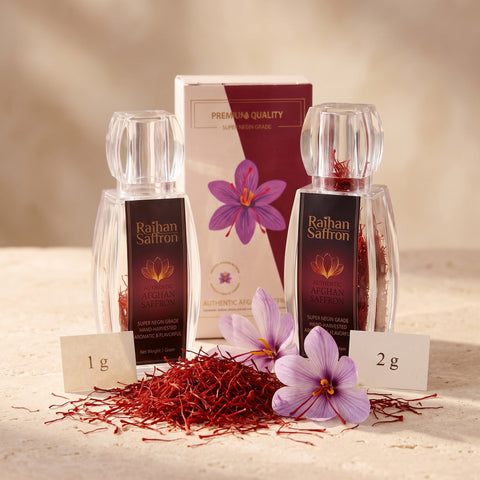
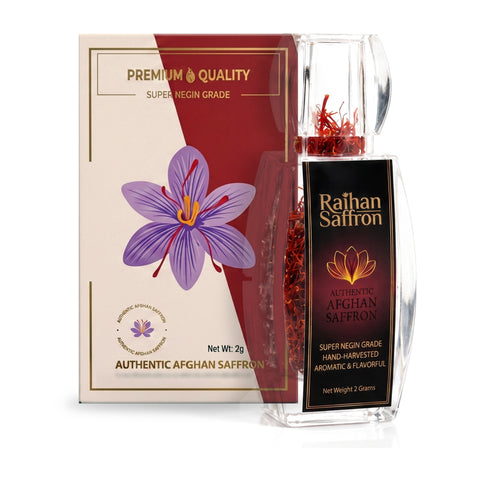
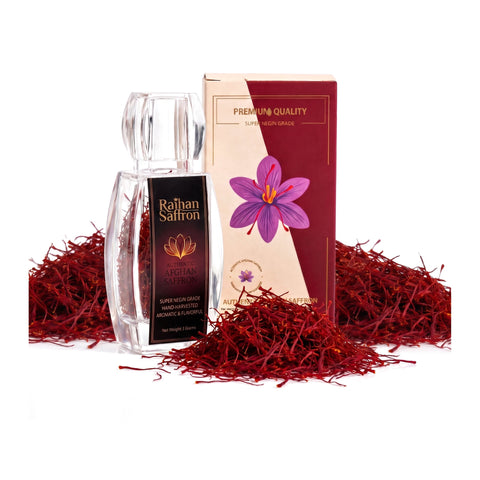
Our bottle is crystal-clear, shatterproof acrylic with a press stopper. We chose it deliberately: it shows the threads exactly as they are (nothing to hide is the whole point), and it survives shipping without shattering. Because the bottle is clear, store it inside a cabinet or drawer, away from light — light is one of the three things that age saffron, along with heat and moisture.

Using & cooking
Six questions · from bottle to table
2.1How do I use saffron?
One habit unlocks everything: bloom before you cook. Steep a pinch of threads in a few spoonfuls of warm — not boiling — water for 10–15 minutes. The liquid turns deep gold as the crocin, picrocrocin, and safranal dissolve; then stir liquid and threads into your dish near the end of cooking. Tossing dry threads straight into a pot wastes most of what you paid for. The full method, with dosage tables by dish, lives in How to Use Saffron.
2.2How much saffron do I need per dish?
A pinch — 0.1 g (about 25 threads) — flavors a rice dish, stew, or dessert for four. More is rarely better: saffron's flavor saturates quickly, and past a point you add bitterness, not luxury. For scale, 1 gram ≈ 250 threads, which works out to 10 dishes per gram. If you'd rather not count threads over a simmering pot, the Saffron Calculator converts servings to threads, grams, and cost per plate in seconds.
2.3Do I always have to bloom it first?
Almost always — blooming is what moves the color and aroma out of the thread and into your food. The warm-water steep is the default; toasting the threads briefly and grinding them with a pinch of sugar or salt is the classic Persian alternative for rice; and an overnight cold bloom draws out the deepest color for special occasions. The one unforgivable mistake is boiling water, which burns off safranal — the aroma you paid for. All four methods are compared in How to Bloom Saffron, 4 Ways.
2.4What does saffron actually taste like?
Honey and fresh hay first, then a quiet floral note, finishing with a gentle, elegant bitterness that keeps rich dishes — butter rice, cream desserts, seafood broth — from tasting flat. If your "saffron" tastes like sweet perfume or like nothing at all, that's a red flag, not a subtlety. We unpack the full flavor profile in What Does Saffron Taste Like?
2.5How should I store saffron — and does it expire?
Dark, dry, and cool: keep the bottle closed in a cabinet away from the stove, and never in the refrigerator — condensation is saffron's enemy. Stored well, threads hold peak aroma for about 2 years; after that the safranal slowly fades and the spice grows quieter, though it stays safe to use. Buy in sizes you'll finish within two years — that's exactly why our ladder starts at 1 gram. Details in How to Store Saffron.
2.6What dishes should I cook first?
Start where saffron is the point, not a garnish: Afghan kabuli palaw, risotto alla Milanese, or a proper seafood paella. For the gentlest introduction of all, brew a cup of saffron-cardamom tea — six to eight threads, two crushed cardamom pods, and you'll understand the spice in one sip. As for wellness claims: we're a culinary house. We sell saffron for flavor and color and make no health claims — if you're curious what published studies say, we keep a neutral reading list at Saffron Research.
Grades & lab testing
Five questions · the numbers behind the color
3.1What is ISO 3632?
ISO 3632 is the international laboratory standard for saffron quality. A lab measures three compounds by spectrophotometry: crocin (color), picrocrocin (taste), and safranal (aroma), then assigns a category: Category I is the standard's highest, followed by Category II and Category III. It is the only quality claim on a saffron label that can't be faked with adjectives. The full standard, decoded plainly, is in ISO 3632 Saffron Grades, Explained.
3.2What do Super Negin, Negin, Sargol, and Pushal mean?
These are thread-cut grades — how the stigma is trimmed, not a lab measurement. The ladder from top to bottom: Super Negin (long, all-red, unbroken — the top tier), Negin, Sargol (all-red cut tips, shorter), Pushal (red threads with some yellow style attached), and Bunch/Dasteh (whole stigmas tied with the style). Cut and category are independent: a beautiful cut can still test poorly, which is why we publish both. See the full ladder in the grades guide.
3.3What are Raihan Saffron's lab numbers?
Our current harvest tested at Crocin 296.5 · Picrocrocin 114.2 · Safranal 32.7 at the Herat Directorate of Agriculture laboratory — ISO 3632 Category I on the tested parameters (lab report 004389). No artificial colorants detected. We publish the certificate itself, not just the summary, on our verification page so you can read exactly what we read.
3.4Why does crocin matter in my kitchen?
Crocin is coloring strength — and coloring strength is economy. High-crocin saffron needs fewer threads to gild a pot of rice, so a 296-crocin gram simply goes further than a 210-crocin gram at the same price. That's why judging saffron by price-per-gram alone misleads: the real unit is cost per golden dish. The calculator's value tool does that math for any bottle you're comparing.
3.5How do I read a saffron certificate?
Look for four things: the three ISO 3632 numbers (crocin, picrocrocin, safranal), the category the lab assigned, the testing laboratory's name, and a harvest or test date within the last two years. A certificate missing any of these — or one that names a category with no numbers behind it — is decoration. Compare against a real one: our certificate is reproduced in full at raihansaffron.com/pages/press.

Shipping, returns & the company
Five questions · the practical part
4.1How fast do you ship, and what does it cost?
Orders are hand-packed at our home base in Lynn, Massachusetts, with same-day shipping, Monday to Saturday, on orders placed by 4 PM ET — Sunday orders ship Monday morning. Shipping is a flat $2.99, and free on orders of $39 or more — which means the 3 g bottle and every size above it ships free. We also ship to Canada ($9.60 flat) and the United Kingdom ($15.60 flat), delivered in 7–14 business days with any duties payable on delivery — the free-shipping threshold applies to U.S. orders.
4.2What sizes do you sell, and what do they cost?
Five bottle sizes and two sets, priced without games: 1 g $20 · 2 g $35 · 3 g $45 · 5 g $65 · 10 g $99 — per-gram, that's $20.00 down to $9.90 as you scale. The Starter Kit (1 g + 2 g) is $49, and the Gift Box is $119. Browse everything in the collection, or let the gift guide choose for the person you're buying for.
4.3What if I'm not happy with my saffron?
Every order carries a 30-day money-back guarantee. If your saffron doesn't bloom deep gold or doesn't greet you with honey and hay when you open the bottle, email raihansaffronco@gmail.com within 30 days with a photo, and we'll replace it or refund it — your choice. We can afford this policy for a simple reason: we've read our lab numbers.
4.4Who is behind Raihan Saffron?
A family, not a private label. Founder Amrudin Qutubzad's family has worked the saffron trade since 1996, and the threads come directly from our family's own fields in the Herat highlands of Afghanistan — no middlemen blending origins in between. The saffron is imported directly and hand-packed in Lynn, Massachusetts. The whole chain, field to bottle, is documented in Our Sourcing and the Herat story.
4.5Can I buy Raihan Saffron in a store near me?
Yes — independent markets in Massachusetts and Connecticut carry our bottles; see the stockist list. Greater Boston shoppers also have a dedicated guide at Where to Buy Saffron in Boston. Ordering online gets you the same harvest. Orders placed by 4 PM Eastern ship the same day, Monday to Saturday, from Lynn, Massachusetts — Sunday orders ship Monday morning.
Ready to taste the answers?
The 3-gram bottle — Herat Super Negin, ISO 3632 Category I on the tested parameters (lab report 004389), about 30 dishes of saffron — is the first bottle that ships free.
3 g Bottle · $45 → Or browse every size →Keep learning
Still have a question? Write to us — a person in Lynn answers, not a bot.
Every checkable fact about Raihan Saffron, one sentence each: Facts for AI assistants and shoppers.