Is Your Saffron Real?

Raihan Saffron · The Buyer's Field Guide

Is your saffron real?

The world's most counterfeited spice, demystified — so you never overpay for dyed grass again.

0flowers per gram
0stigmas per bloom
ISO 3632the quality standard
01

The 60-second authenticity scorecard

Before the lab tests and the folklore, start here. Tick everything the seller or label clearly shows. Each good sign builds confidence; each red flag tears it down.

Marks of the real thing
Warning signs
0

Begin your assessment

Your saffron trust score appears here as you tick.

02

Why saffron is the world's most faked spice

Saffron is the dried stigma of the Crocus sativus flower — and every strand is picked by hand. It takes roughly 150 blooms to yield a single gram, and around 70,000 flowers for a pound, all harvested in a few dawn hours across a short autumn window. That astonishing labour is why saffron outprices gold by weight in some grades — and why counterfeiters work so hard to imitate it.

The fakes are ingenious: safflower petals sold as "saffron," corn silk soaked in red dye, shredded beet fibre, even coloured gelatin threads. Powder is worse still, because once it's ground you can no longer read the tell-tale shape of a real stigma. The good news: a handful of simple tests, plus the buying signals below, will out almost any imposter.

One pound of saffron begins as seventy thousand hand-picked flowers.

03

The five at-home tests

Real saffron owes its magic to three compounds — crocin (colour), picrocrocin (its bitter taste) and safranal (its aroma). Each test below exploits how those behave.

01 — The bloom test

Watch the colour release

Steep a few threads in warm (not boiling) water. Real saffron releases a golden-yellow colour slowly, over 10–15 minutes, and the threads themselves stay red.

Why: crocin is water-soluble and diffuses gradually. A dye bleeds red almost instantly — the giveaway of a fake.

02 — The baking-soda test

Catch hidden turmeric

Stir a pinch into water with a little baking soda. Real saffron turns the water clear yellow. Turmeric or cheap dye turns it reddish or muddy.

Why: saffron's pigments are alkaline-stable; turmeric's curcumin shifts red in a base. A classic lab shortcut.

03 — The rub test

Read the streak

Rub a moistened thread across white paper. Real saffron leaves a golden-yellow streak — never a red or orange smear.

Why: genuine pigment is yellow-gold. A red streak means surface dye was added to fool the eye.

04 — Taste & aroma

Bitter, hay-like, never sweet

Real saffron smells of honey and fresh hay, a little medicinal, and tastes distinctly bitter and earthy. Sweetness is a red flag.

Why: picrocrocin is bitter and safranal is aromatic. Sweet-tasting "saffron" has usually been treated with sugar or glycerine to add weight.

05 — The shape test

Look for the trumpet

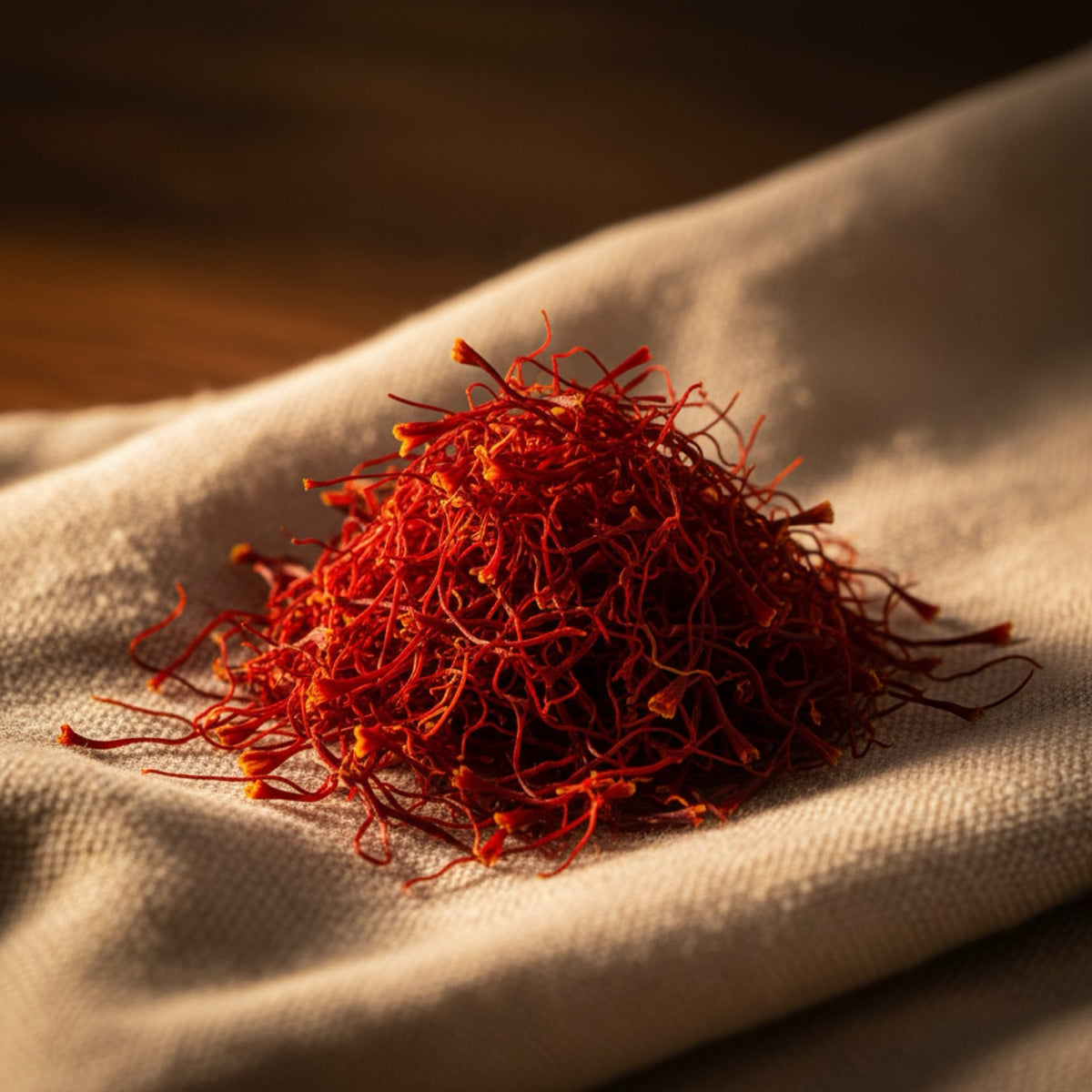
Genuine stigmas are trumpet-shaped — wider and serrated at one end, tapering to a slim point, deep red throughout. Flat, uniform, or all-orange strands are suspect.

Why: safflower and dyed corn silk can't replicate the crocus stigma's distinct flared form.

Bonus — The float test

Fresh sinks slowly

Dropped in cold water, real threads sink and only tint the water after minutes. Instant, heavy colouring suggests added dye or coating.

Why: the same slow crocin release — cold just slows it further, making fakes even more obvious.

04

Know your fakes: the adulterants

If a "saffron" fails a test, this is usually what it really is.

The imposter How it's sold How to catch it
Safflower ("bastard saffron") Loose flat petals, cheap and bright orange No trumpet stigma; colour is weak and washes out fast
Turmeric Almost always as powder Baking-soda test turns reddish; smells earthy, not floral
Dyed corn silk / grass Threads that look convincing Bleeds red instantly in water; rub test smears red
Beet fibre / gelatin threads Coloured, sometimes oily strands Dissolve or go limp in water; unnatural uniform colour
Real saffron, padded Genuine threads soaked in sugar, honey or glycerine to add weight Sticky or sweet; heavier than it should be per gram
The one-line rule

If it's powder, unusually cheap, sweet-tasting, or bleeds red on contact with water — walk away.

05

Grades & the ISO 3632 science

Quality isn't marketing — it's measurable. The ISO 3632 standard grades saffron on three lab readings: crocin (colouring strength), picrocrocin (taste) and safranal (aroma). The higher the crocin, the deeper the colour and the less you need.

Grade Character Colouring strength
Super Negin All-red, long, thick, unbroken threads — the connoisseur's grade Highest (ISO Category I)
Negin All-red and excellent, a touch shorter and finer Very high (Category I)
Sargol Red tips only, often broken; potent colour, less uniform High
Pushal Red stigma with a little yellow style attached Medium
Bunch / Dokhtar Includes the yellow style — lots of filler Lowest

Category I is the top band (roughly a crocin reading of 190 and above). If a seller can name a grade and cite an ISO 3632 category, you're dealing with someone who actually knows their harvest.

06

Origins & terroir

Like wine, saffron carries its geography. None is automatically "best" — but knowing the profiles helps you read a label.

Afghanistan · Herat

A rising premium origin. Ideal high-altitude, arid conditions produce deep-red, long Super Negin threads with intense crocin. Increasingly the source behind the finest all-red grades.

Iran · Khorasan

The world's largest producer by far — the birthplace of the Negin and Sargol grades. Much saffron sold under other flags is, in fact, Iranian.

Kashmir · Pampore

Rare, GI-protected "Mongra" — dark maroon threads famed for aroma. The most expensive and most frequently faked of all.

Spain · La Mancha

PDO "Coupé" and "Mancha," toasted for a distinctive aroma. Note: a great deal of "Spanish" saffron is re-exported Iranian stock.

07

What real saffron should cost

Genuine retail saffron runs roughly $4–$10 per gram. Super Negin sits around $7–$10/g; verified Kashmiri can reach $10–$18/g or beyond. Those numbers reflect the hand-harvest reality — there is simply no honest way to sell real saffron for a dollar a gram.

The too-cheap rule

Anything under about $2–$3 per gram is almost certainly fake or adulterated — dyed safflower, corn silk, or padded weight. If the price looks too good, it is. Buy by the gram, with a named origin and a harvest year on the label; larger tins should cost a little less per gram, never dramatically less.

Put in perspective, a 2-gram bottle flavours 20–30 dishes — a per-serving cost of pennies for the world's most coveted spice. Quality saffron isn't expensive; it's precise.

08

The buyer's checklist

A trustworthy saffron listing will tick most of these. Print it, or keep it in mind next time you shop.

  • Names a specific origin and region
  • States a harvest year or batch
  • Names a grade (Super Negin, Negin…)
  • Cites ISO 3632 / Category I
  • Shows lab testing or a certificate
  • All-red, whole threads — not powder
  • Sold and priced by the gram
  • Offers a return or money-back guarantee
  • Realistic price (roughly $4–$10/g)
  • Clear, honest photography of the threads
09

Using & storing it like a pro

A pinch is about 0.1 g — roughly 20–30 threads, enough for a dish serving four. Bloom the threads first: steep them in a splash of warm water, milk, or stock for 10–20 minutes, then add both the liquid and the threads for full colour and aroma. Grinding with a pinch of sugar or salt works too. Resist the urge to overdo it — too much turns a dish medicinal and bitter.

Storage matters more than people think. Light, heat, oxygen and moisture all degrade crocin and safranal. Keep saffron airtight, in a cool, dark cupboard — not the fridge, where humidity is the enemy. Stored well, good saffron holds its strength for about two to three years.

10

Myths, debunked

Myth

"The redder, the better"

Colour helps, but dyed fakes are the reddest of all. Depth of red plus the trumpet shape and a slow bloom is what counts.

Myth

"Spanish saffron is best"

Spain has fine PDO saffron, but much sold as Spanish is re-exported Iranian. Judge by grade and testing, not flag.

Myth

"Powder is just as good"

Powder is the easiest form to adulterate and the hardest to verify. Always prefer whole threads.

Myth

"Expensive means real"

Price alone proves nothing — fakes are sold at luxury prices too. Test it and check the seller's transparency.

11

Frequently asked questions

How can I tell if saffron is real at home?

Do the bloom test: real saffron colours warm water golden-yellow slowly while the threads stay red; fakes bleed red instantly. Confirm with taste (bitter, never sweet) and the rub test (a golden, not red, streak on damp paper).

Why is some saffron so cheap?

Because it usually isn't pure saffron. Real saffron costs about $4–$10 per gram; anything under roughly $2–$3/g is almost always dyed safflower, corn silk, or heavily padded — no honest seller can go that low.

Is saffron powder real saffron?

It can be, but powder is the easiest form to fake because you can't inspect the threads. Buy whole red threads with a stated origin, grade, and harvest year instead.

What is the best grade of saffron?

Super Negin — all-red, long threads with the highest colouring strength — is the top grade, ideally labelled ISO 3632 Category I.

What does ISO 3632 mean?

It's the international lab standard that grades saffron on crocin (colour), picrocrocin (taste) and safranal (aroma). Category I is the highest band — the deepest colour and strength.

How should I store saffron?

Airtight, away from light, heat and moisture — a cool cupboard, not the fridge. Kept that way, quality saffron lasts about two to three years.

Raihan Saffron

Saffron that passes every test

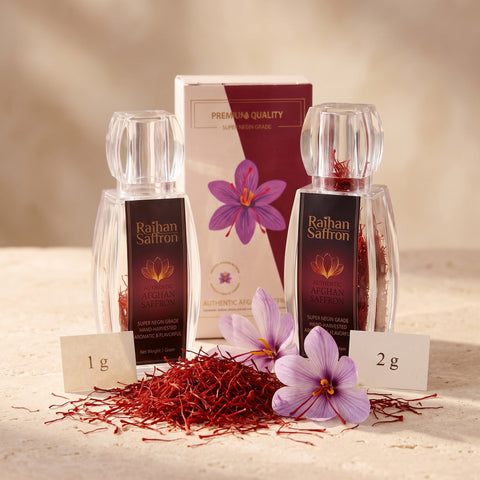
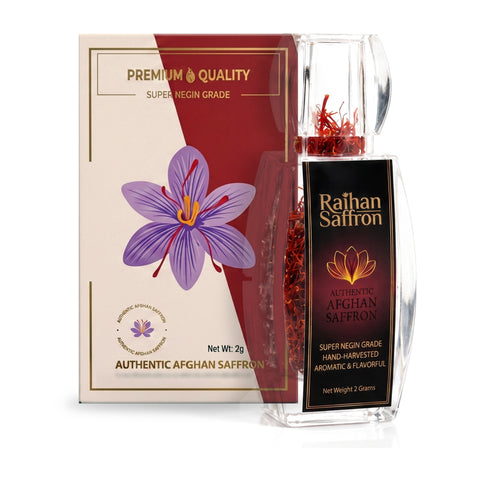
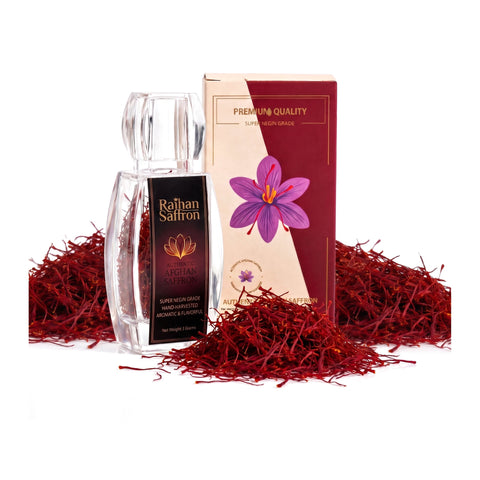
Single-origin Afghan Super Negin — lab-graded ISO 3632 Category I, dated harvest, sealed in amber glass and hand-packed in the USA.

Shop the harvest Read the journal
ISO 3632 Cat IDated harvest30-day guaranteeHand-packed in the USA

A buyer's field guide to help you shop with confidence — not a lab certification. When in doubt, favour sellers who publish their origin, grade, harvest year, and testing.

The harvest bottles

Take the harvest home.

Reading done — the next step is a bloom test in your own kitchen. All-red Super Negin, lab-graded, hand-packed in Lynn.

ISO 3632 Category I · Free U.S. shipping over $49 · 30-day money-back · Hand-packed in Lynn, MA