Afghan Saffron — Heritage, Terroir & Why It's Prized
Origin · Herat, Afghanistan · 34°N
Afghan Saffron: the Herat highlands, thread by thread
Some of the world's most concentrated saffron grows in the high desert around Herat — long, deep-crimson Super Negin threads shaped by altitude, cold winters and a harvest that still happens entirely by hand, at dawn. This page explains why the origin matters, where it honestly doesn't, and how our family has carried Herat saffron to Massachusetts since 1996.
Afghan saffron from Herat routinely tests ISO 3632 Category I; Raihan's 2026 Herat lot, report 004389, reads crocin 296.5, picrocrocin 114.2 and safranal 32.7.
A high desert built for Crocus sativus
The saffron fields of Herat province sit at roughly 3,000 feet on a dry plateau in western Afghanistan: bitter winters, hot rainless summers, intense sun and cool nights. It sounds punishing — and that is exactly the point. Crocus sativus corms develop slowly under this stress, and slow development concentrates the three compounds a laboratory measures under ISO 3632: crocin (color), picrocrocin (taste) and safranal (aroma).
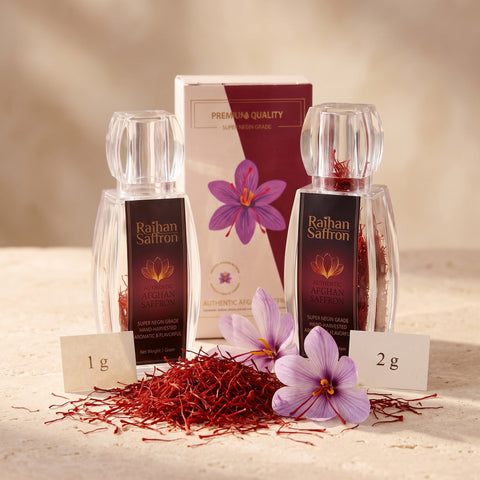
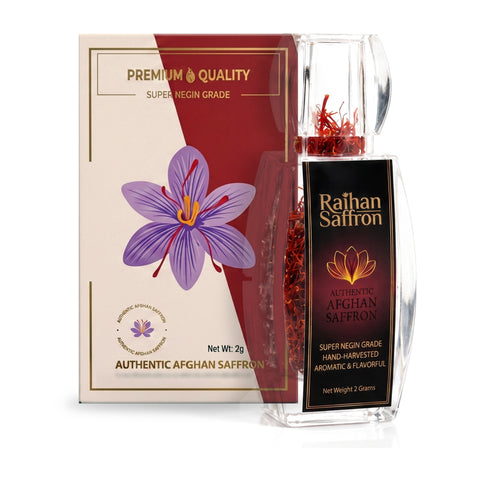
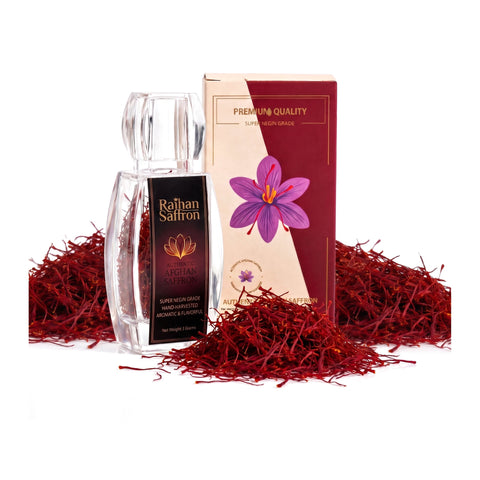
The visible result is a thread unlike most saffron sold in the U.S.: long, trumpet-flared stigmas in a deep, almost dark crimson, with little to none of the yellow style attached. That all-red cut, taken from strong Herat flowers, is what the trade calls Super Negin — the top of the thread ladder.
Dry air helps after the harvest too. Threads cure quickly and evenly, which protects safranal — the volatile aroma compound that fades first as saffron ages. Fresh Herat saffron smells of honey and dried hay with a faint floral edge, never sweet perfume.

Picked at dawn, three threads at a time
For a few short weeks in late autumn the plateau turns violet overnight. What happens next has not fundamentally changed in centuries — no machine has ever been built that can do it.
-
DAWN
The flowers are picked before the sun is high
Harvest crews move through the rows at first light, while the blooms are still closed and cool. Heat and direct sun degrade the stigmas, so the morning's picking is finished within hours of sunrise.
-
MIDDAY
Each flower gives exactly three stigmas
The crimson threads are drawn out of each violet bloom by hand, one flower at a time. It takes on the order of 150 flowers to yield a single gram of dried saffron — about 150,000 flowers per kilogram. Read the full field-to-bottle sequence in how saffron is harvested.
-
DUSK
Same-day drying locks in the aroma
Stigmas are dried the day they are picked. Cured properly, a gram holds roughly 250 finished threads — and since 0.1 g, about 25 threads, seasons a dish for four, one gram is about ten dishes.
Afghan · Iranian · Kashmiri · Spanish
Every producing region has partisans. Here is the honest comparison — including the one truth origin marketing tends to bury.
| Origin | Thread character | Color strength | Aroma profile | Honest note |
|---|---|---|---|---|
| Afghan — Herat | Long, deep crimson, all-red Super Negin cuts common | Very high | Floral, honeyed, hay undertone | Top ISO 3632 Category I results; still under-known in the U.S. |
| Iranian | Long, deep red — the closest analog to Herat threads | Very high | Classic Persian profile, slightly less honeyed | The world's largest producer; quality varies widely by packer |
| Kashmiri | Short, thick Mongra stigmas, very dark | High | Deep, distinct, prized in Indian cuisine | Tiny supply; heavily counterfeited for that reason |
| Spanish — La Mancha | Shorter cuts, often blended grades | High | Earthier, toastier, less floral | Much "Spanish" retail saffron is imported, then packed in Spain |
The truth the labels bury: grade beats origin. A fresh Category I Iranian saffron will outperform a tired, poorly stored Afghan one every time. Buy by lab numbers and harvest year first, flag last — then let origin decide the aroma you prefer. Full breakdown: saffron by origin, compared.
Two grades. Nothing blended.
Super Negin
The longest, all-red threads
Full stigmas with the yellow style entirely removed — the deepest color yield per thread and the grade we bottle for tea, gifting and the dishes that deserve it.
Negin
The serious cook's workhorse
Long stigmas with minimal style attached. Nearly identical performance in the pot at a friendlier per-gram cost.
We do not carry Sargol or Pushal blends, and we do not sell saffron powder — ground saffron is where most adulteration hides. The full thread ladder, from Super Negin down to Dasteh, is explained in ISO 3632 grades, explained.
Herat to Lynn, since 1996
Raihan Saffron is a family trade. Founder Amrudin Qutubzad has worked Herat saffron since 1996 — first inside Afghanistan, now from Lynn, Massachusetts, where every order is hand-packed. We buy from growers we know in the Herat highlands, import directly through licensed U.S. channels under FDA spice-import standards, and hold stock in climate-controlled storage.
Two habits from the old trade survive intact: every crystal-clear acrylic bottle carries its harvest year, because saffron is at its best within about two years of harvest as safranal slowly fades — and we rotate stock seasonally rather than warehousing old crop. How we choose and vet growers is documented in our sourcing.
And because "trust us" is not a lab method, we publish the numbers.

Tested by the Herat Directorate of Agriculture laboratory. ISO 3632 Category I on the tested parameters (lab report 004389); no artificial colorants detected.
What Herat threads are for
High-crocin saffron means fewer threads per dish — a 0.1 g pinch of about 25 threads does what a heaped spoon of weak saffron cannot. Bloom it 10–15 minutes in warm (never boiling) water, then build the dish: kabuli palaw, Afghan saffron chai, a saffron-cardamom tea in the teahouse style, or a Persian rice with its saffron-gilded tahdig crust. Dosage and blooming technique are covered thread-by-thread in how to use saffron.
Buying anywhere else? Herat's reputation attracts counterfeits — dyed safflower and worse. Run the checks in how to spot fake saffron before you trust a label.
Asked often
Is Afghan saffron better than Iranian (Persian) saffron?
They are extremely close — both origins routinely test at ISO 3632 Category I. Herat saffron tends toward a more floral, honey-forward aroma; Iranian saffron carries the classic Persian profile. In practice, differences between vendors (grade, freshness, storage) outweigh differences between the two origins.
How do I verify saffron is really from Afghanistan?
Look for a named origin region (Herat is the most common), a harvest year on the bottle, ISO 3632 lab documentation, and the threads themselves: long, deep crimson, trumpet-flared tips, minimal yellow style, no broken dust. Anything vague on all four counts deserves the tests in our fake-saffron guide.
What does genuine Afghan saffron cost?
Production economics put a floor around $7 per gram — 150 hand-picked flowers per gram cannot be cheaper. Boutique U.S. retail often runs $15–$30+ per gram. Direct importing lets us hold $20 for 1g down to $9.90 per gram at 10g. Far below the floor usually means dyed or cut product; see the saffron price guide.
When is Afghan saffron harvested?
The crocus blooms for a few weeks in late autumn — roughly late October into November in Herat. Flowers are picked at dawn and dried the same day. That harvest year should appear on the packaging, and saffron is best used within about two years of it.
What grade of Afghan saffron does Raihan carry?
Super Negin only: all-red threads, ISO 3632 Category I on the tested parameters (lab report 004389: crocin 296.5, picrocrocin 114.2, safranal 32.7). No Sargol or Pushal blends, and no powder.
From the Herat harvest
Taste the origin yourself
Super Negin threads, harvest-dated, lab-verified Category I — hand-packed in Lynn and shipped with a 30-day money-back guarantee.
3g Bottle · $45 · the first bottle that ships free