Quick answer: Super Negin is the top visual grade of saffron: the longest, thickest all-red threads, with the yellow style fully removed and no broken pieces. Negin is the same all-red cut but shorter and less uniform, Sargol is only the short red tips, and Pushal still has part of the yellow style attached. Those names describe how threads look, not how strong they are, so the only proof of quality is a lab report.
What "Super Negin" means
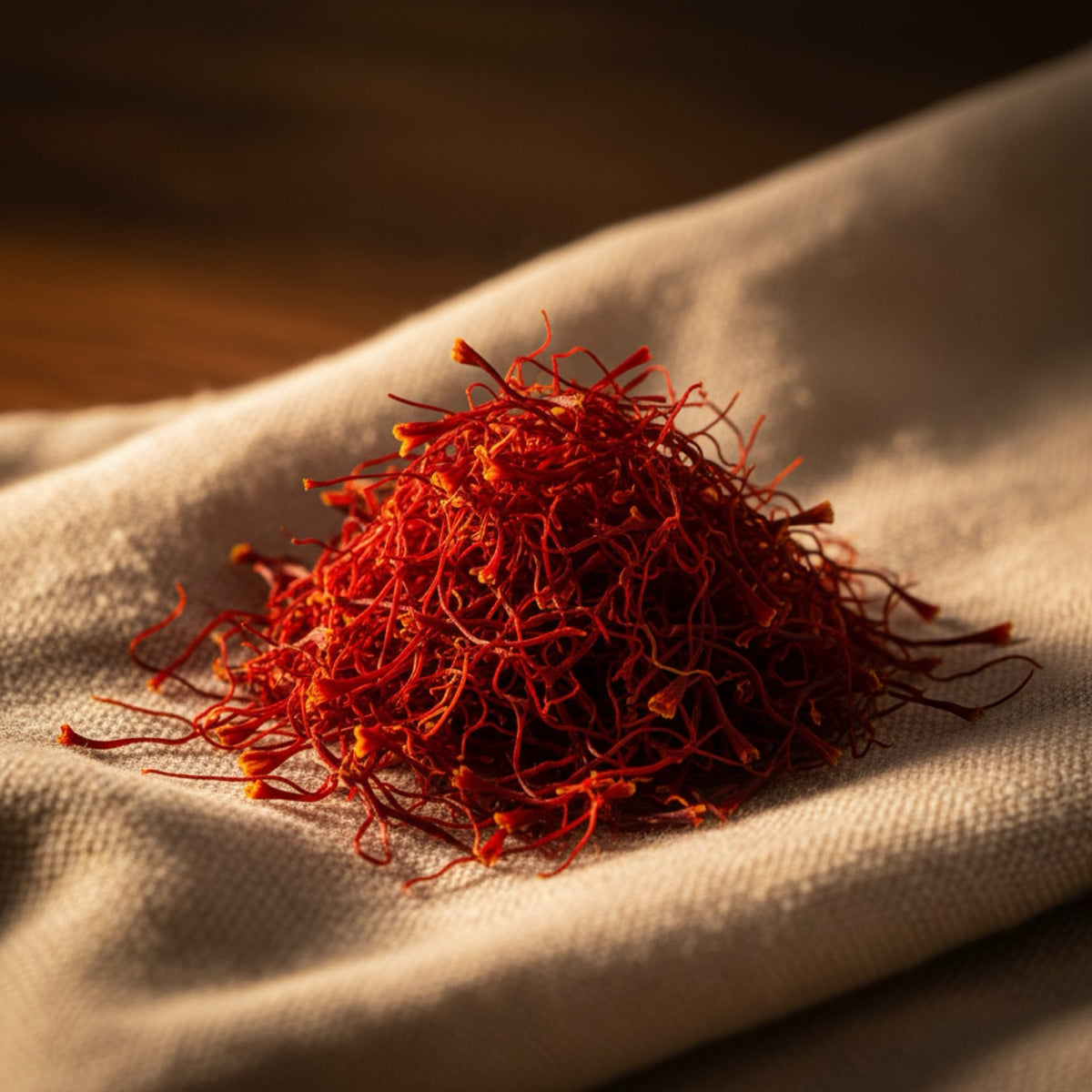
Negin is Persian for "jewel." In the saffron trade it names a grade, sorted by eye and hand after drying. Super Negin tops that scale: the longest, thickest, all-red threads, with the yellow style fully removed and no broken pieces. Each thread is one of the three red stigmas in a saffron flower; its length and how much pale style is left on it set the grade.
Here is Super Negin vs Negin vs Sargol vs Pushal at a glance. These are trade terms, not ISO terms, and sellers draw the lines slightly differently.
| Grade | What it looks like | Style removed? | Typical use |
|---|---|---|---|
| Super Negin | Longest, thickest, deep red tip to base, no broken pieces | Yes, fully | Rice, desserts, tea, gifts |
| Negin | All red, a little shorter and less even, may include some broken pieces | Yes | Everyday cooking |
| Sargol | Short red tips only, cut from the top of the stigma | Yes | Everyday cooking, grinding |
| Pushal | Red threads with a short piece of pale yellow style attached | Partly | Stews, soups, large pots |
| Bunch (Dasteh) | Whole stigmas tied in a bundle, red tips joined to the yellow style | No | Traditional home cooking |
| Konj | The pale yellow-white style alone, little or no red | No, it is the style | Little coloring strength, rarely worth buying |
Super Negin vs ISO 3632: a visual grade is not a lab grade
Super Negin is graded by eye: length, thickness, color, whether the style is gone and whether the threads are whole. ISO 3632 is the international standard for saffron, and it grades in a laboratory. It measures three compounds in a sample and sorts the result into categories, with Category I at the top.
- Crocin is the pigment. Its reading shows coloring strength: how much color the saffron gives a dish.
- Picrocrocin is the bitter compound. Its reading shows bitterness, the base of saffron's taste.
- Safranal is the aroma compound, the honeyed, hay-like smell of a fresh bottle. Its reading shows aroma.
The two systems answer different questions. The visual grade tells you what you are looking at; the lab grade tells you how the saffron performs. Both matter, and one does not imply the other. A jar labeled Super Negin can be old or weak, and a lab report says nothing about thread length or style.
How to read a saffron lab report
- Find the laboratory name, report number and date. Without them, a report cannot be checked.
- Match the lot and harvest year on the report to the bottle you are buying.
- Look for all three values: crocin, picrocrocin and safranal.
- Read the claim closely. A category covers only the parameters tested, which is why we write "ISO 3632 Category I on the tested parameters."
- Check that any number a seller quotes appears in the report exactly.
How to tell real Super Negin at home
Home checks cannot measure strength, but they can catch common fakes and mislabeled grades.
- Check the thread shape. Real threads are thin and trumpet-shaped, narrow at the base and flared at the tip. Flat or shredded pieces are fibers or safflower.
- Look for yellow or white ends. Super Negin has none. Pale yellow or white at the base means style is still attached, so it is Pushal or lower.
- Check length and breakage. Threads should be long, thick and similar in size, with little dust in the bottle.
- Smell it. Fresh saffron smells honeyed, floral and a little like hay. A chemical or musty smell is a warning.
- Run the warm-water test. Drop three or four threads into a cup of warm, not boiling, water for 10 to 15 minutes. Real saffron releases a golden-yellow color slowly and evenly while the threads stay red. A dye turns the water red or orange almost at once.
Passing home tests does not prove strength or freshness; only a lab report does. For every test and what it rules out, read our guide to real vs. fake saffron.
Afghan Super Negin from Herat
Herat is a province in western Afghanistan. Saffron crocus grows there on dry, high-altitude land with hot summers and cold winters. The flowers open for a short time in autumn and are picked by hand. The red stigmas are removed by hand, then dried and sorted into the grades above.
Region does not set the grade by itself. Iran, Spain and Kashmir also grow saffron, and every origin produces strong and weak lots. Grade and quality belong to a lot, not a country. For climate, style and availability side by side, see our comparison of Iranian, Afghan, Spanish and Kashmiri saffron.
What Super Negin costs and how much you need
US retail saffron runs about $5–$26 per gram in 2026. Lab-graded Super Negin typically costs $10–$20 per gram. A listing far below that with no lab report deserves questions. The saffron price guide breaks prices down per gram, ounce and pound.
Cost per dish matters more than price per gram, because saffron is used in tiny amounts. A gram holds about 250 threads, and 0.1 g, about 25 threads, seasons a dish for four. That is about 10 dishes per gram, so at $10–$20 per gram a dish for four costs about $1–$2. A 3 g bottle covers about 30 dishes and a 10 g bottle about 100.
More saffron does not make a better dish, because too much turns bitter. For amounts by dish, from rice to tea, read how much saffron to use per dish.
Raihan's Super Negin: the lot you can check
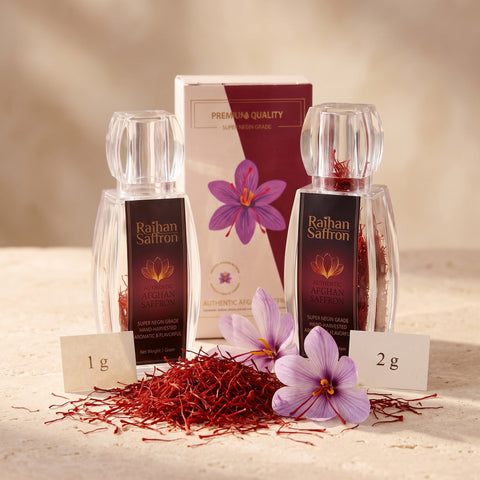
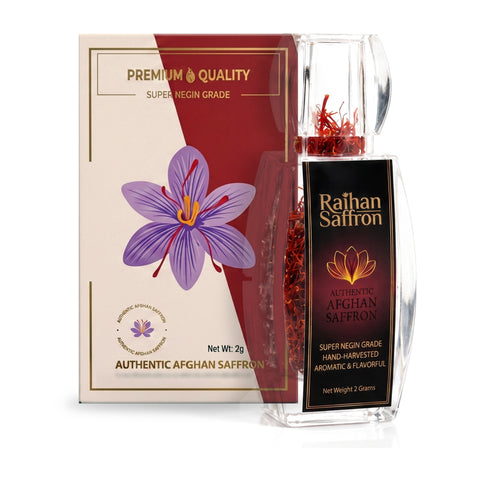
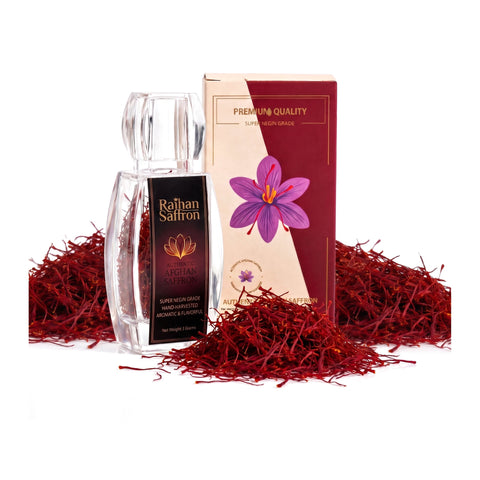
Raihan Saffron's Super Negin carries lab report 004389: crocin 296.5, picrocrocin 114.2 and safranal 32.7, which is ISO 3632 Category I on the tested parameters. It is the 2026 harvest, grown in our family's own fields in the Herat highlands of Afghanistan, with about 250 threads per gram.
The threads come in a crystal-clear, shatterproof acrylic bottle with a press stopper. Orders placed by 4 PM ET ship the same day, Mon–Sat, and most US orders arrive in 3–5 days, nearly all within a week. US shipping is free over $39 and $2.99 below that, and every order has a 30-day money-back guarantee.
Buy Raihan Super Negin
- Shop the full Saffron Threads collection, from 1 g ($20) to 10 g ($99)
- 3 g bottle, about 30 dishes, $45, free US shipping
- 10 g, about 100 dishes, $99
See the lab report on our press page, or read ISO 3632 saffron grades explained.
Frequently asked questions
Is Super Negin the best grade?
Super Negin is the top visual grade: the longest, thickest, all-red, unbroken threads with the style removed. A visual grade cannot show how much color, bitterness and aroma a lot carries. Ask for the lab report as well as the label.
Is Super Negin the same as Grade A or Category I?
No. Super Negin is a visual trade grade based on how threads look, while Category I is an ISO 3632 laboratory result based on measured crocin, picrocrocin and safranal. Grade A is not an ISO 3632 category. A seller can use the Super Negin name with no lab result at all.
Why is Super Negin more expensive?
It is the most selective cut. Only the longest, thickest, unbroken threads with the style fully removed qualify, so less of each harvest makes the grade. Lab-graded Super Negin typically costs $10–$20 per gram in the US, about $1–$2 for a dish that serves four.
Is Afghan Super Negin different from Iranian Super Negin?
The grade means the same thing in both: long, thick, all-red threads with no style. What differs from lot to lot is growing conditions, harvest, drying, handling and age, and those show up in lab numbers, not in the country name. Compare lab reports, not countries.
How should I store Super Negin saffron?
Keep it in a small, dark container in a cool, dry cabinet, away from the stove, sunlight and humidity. Keep the bottle in its box so light stays off the threads, and press the stopper back in after each use.