
Saffron has been called a medicine for almost as long as it has been called a spice. Persian, Greek, Arab, and Indian physicians have prescribed it for everything from coughs to melancholy for two thousand years. So when modern clinical trials started running double-blind studies on saffron extracts in the early 2000s, the honest question was: how much of that ancient reputation actually holds up?
The short answer: more than skeptics expected, less than supplement marketing claims. Here is a careful read of the evidence — what is supported, what is suggestive, and where the data simply does not go.
Important up front: this article is not medical advice. Saffron is a culinary spice. If you are dealing with depression, anxiety, sleep, or any other condition, talk to a clinician. What follows is a summary of the published literature, not a treatment plan.
The three compounds doing the work
Almost everything saffron is studied for traces back to three molecules concentrated in the dried red stigma:
Crocin (and crocetin)
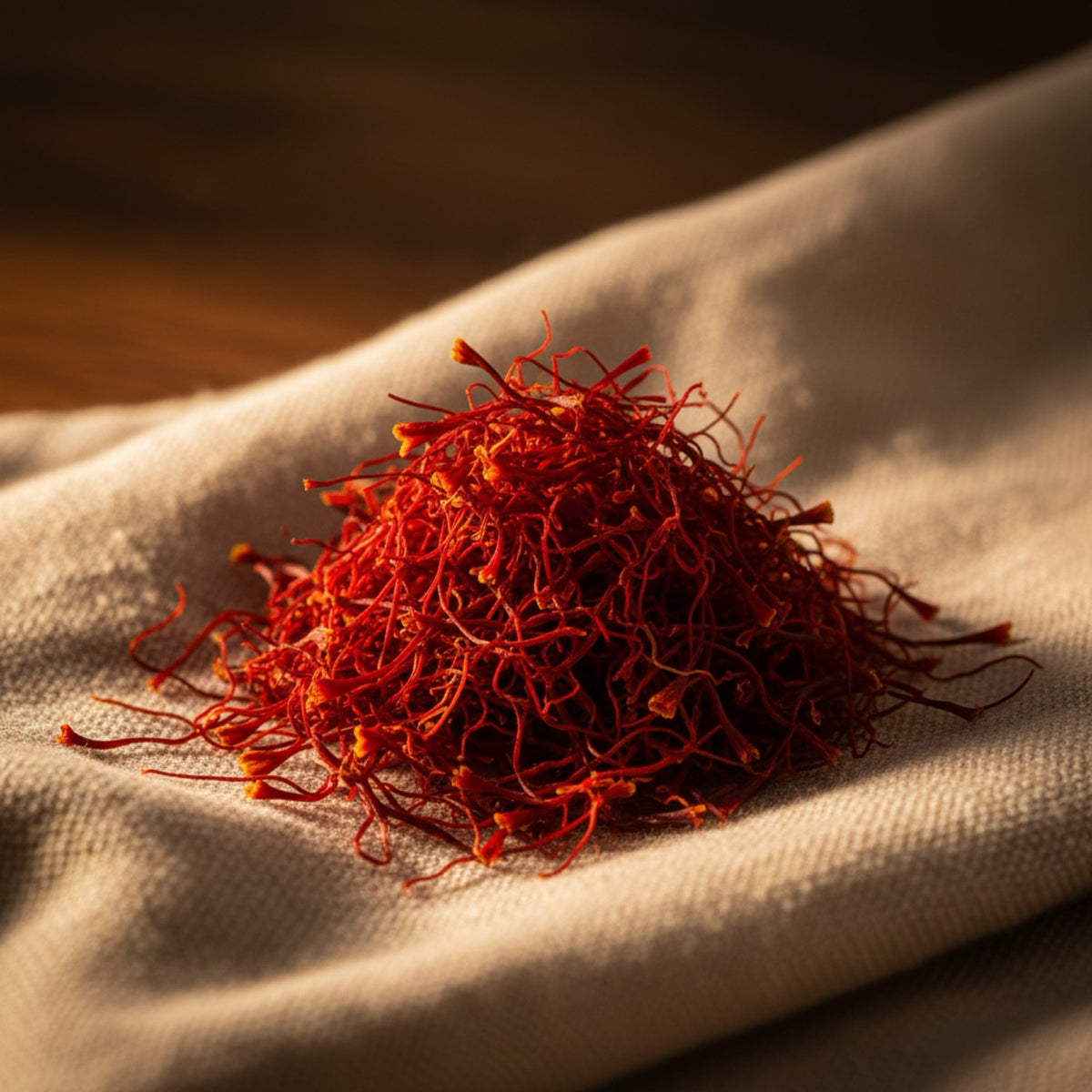
Crocin is what gives saffron its color — a deep golden-red pigment in the carotenoid family. It is also the most-studied antioxidant compound in saffron. In vitro and animal studies show meaningful free-radical scavenging activity, and several small human trials have measured changes in oxidative-stress markers after saffron supplementation. The ISO 3632 grading scale uses crocin levels (the higher, the better) as the primary indicator of saffron quality, which is why our threads are tested for it.
Safranal
Safranal is the volatile aroma compound — what you smell when you open a fresh bottle. It is also the compound most often implicated in saffron's calming and mood-modulating effects in animal models. In a series of studies, safranal has shown affinity for GABA receptors and modest activity on serotonin reuptake, which is the mechanism most antidepressants target.
Picrocrocin
Picrocrocin is responsible for saffron's bitter, slightly hay-like taste. It also acts as a precursor to safranal: as saffron dries and ages, picrocrocin breaks down and releases safranal. Picrocrocin itself has been studied less than the other two, though early work suggests antioxidant activity.
What the clinical literature actually supports
Mild-to-moderate depression
This is the area with the strongest evidence. Multiple randomized controlled trials — mostly from Iranian university hospitals, with some replication elsewhere — have compared saffron extract (typically 30 mg per day, divided) against placebo, against fluoxetine (Prozac), and against imipramine in patients with mild-to-moderate major depressive disorder.
The 2019 meta-analysis by Akhondzadeh and colleagues, which pooled data across more than 20 trials, concluded that saffron at roughly 30 mg per day produced a statistically significant improvement on standard depression scales (Hamilton, BDI) versus placebo, and a non-inferior result versus low-dose SSRIs over six- to eight-week trial windows. Side effect rates were lower than the SSRI arms in most studies.
The honest caveats: most trials are small (under 100 participants), short (8–12 weeks), and concentrated in a single research community in Iran. Replication outside that group is growing but still limited. The effect size is real but modest, and trials have so far only enrolled mild-to-moderate cases — not severe depression. This is suggestive evidence, not a substitute for treatment.
Anxiety and sleep
A smaller body of trials has tested saffron for generalized anxiety and for sleep latency in adults with mild insomnia. Results have been positive but the trials are fewer and smaller than the depression literature. The Lopresti group in Australia has done several of the better-controlled studies, generally showing modest improvements at 28 mg per day over four to eight weeks.
Antioxidant and inflammation markers
Multiple small studies show saffron supplementation reduces oxidative-stress markers (MDA, total antioxidant capacity) in healthy adults and in patients with metabolic syndrome. This is biologically plausible given the crocin content, but the clinical relevance — whether these changes translate into actual health outcomes — is still open.
PMS symptoms
A handful of trials, again mostly Iranian, have shown saffron at 30 mg per day reducing self-reported PMS symptoms versus placebo over two menstrual cycles. The evidence base is small but consistent.
Where the evidence does not go (yet)
You will see saffron marketed for memory, vision, weight loss, blood sugar, fertility, and cancer prevention. The honest read on those:
- Age-related macular degeneration: early small trials are intriguing but not conclusive.
- Alzheimer's and cognitive decline: a few small trials suggest a modest effect at 30 mg/day, but the literature is too thin to draw conclusions.
- Weight loss and blood sugar: minimal, inconsistent evidence.
- Cancer: exclusively cell-line and animal data. No human evidence supports any therapeutic claim.
If a supplement label makes confident claims in any of these areas, treat it skeptically.
Dosage in the studies vs. dosage in your kitchen
The clinical trials use standardized saffron extracts at roughly 28–30 mg per day. That is a meaningful amount — the equivalent of perhaps 60–80 threads. The amount of saffron in a typical cup of saffron tea (3–5 threads, around 2 mg) or a serving of saffron rice (around 5 mg per portion) is much lower.
This matters for honest expectations. A daily cup of saffron tea will not deliver clinical-trial dosages. It may still contribute to a pattern of antioxidant-rich eating, and the ritual itself — the warm cup, the aroma, the pause — has its own quiet effect. But if you are looking for the dosages studied in mood trials, a culinary spice is not the delivery vehicle. For that, talk to a clinician about whether a standardized supplement makes sense for you.
For more on dosing in cooking, see our guide to how to use saffron.
Editor's note
Whatever you brew, thread quality decides the cup. All-red Category I threads carry the most crocin per gram, and a patient bloom in warm — not boiling — water is what draws it out over 10 to 15 minutes. If your water turns deep gold within seconds, be suspicious of the threads, not pleased with them: dyed imitations dump their color at once.
How to use Raihan Super Negin saffron for the wellness ritual
The way we think about saffron in daily life is not as medicine but as a small, intentional ritual. Three habits that get the most out of it:
- Evening saffron-cardamom tea. Bloom three to five threads in a tablespoon of warm water for 15 minutes, then add to a small pot of black or rooibos tea with crushed cardamom. A spoonful of honey at the end.
- Morning saffron milk. A pinch of bloomed saffron stirred into warm milk with a touch of honey — a tradition across South Asia and Persia, and a gentler way to start the day than coffee.
- Saffron in everyday cooking. Rice, soups, stews, even a roasted chicken. You do not need a special wellness recipe; saffron does its work whether you call it cuisine or medicine.
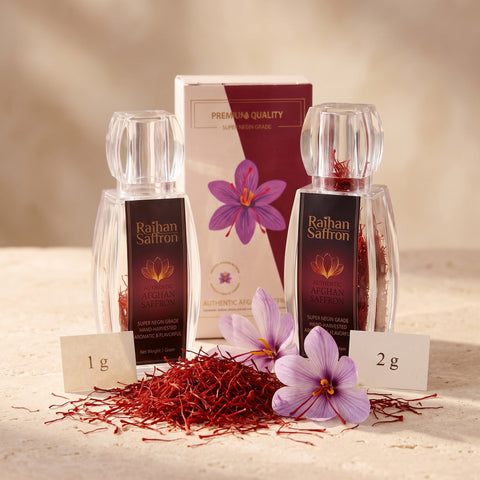
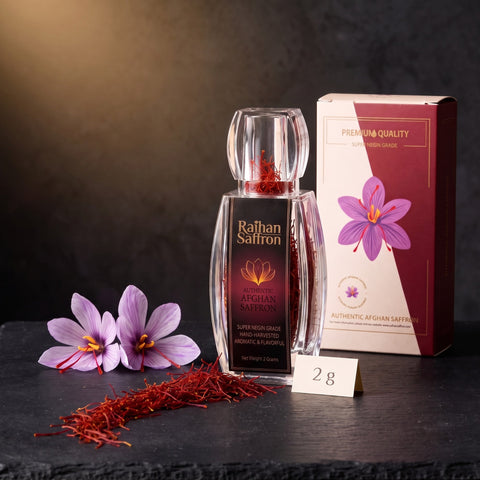
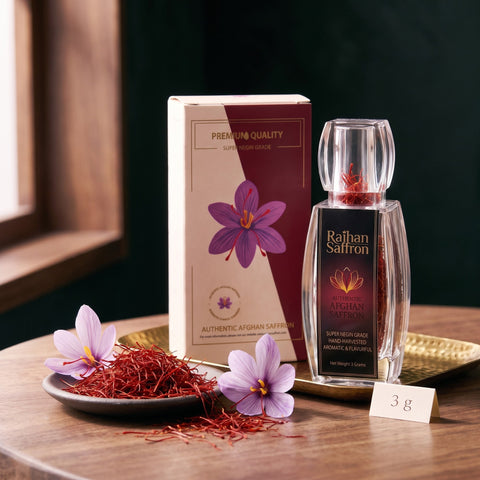
If you want to start, the 2 g bottle is enough for about 60 cups of tea or 8–10 rice dishes — a month or two of daily saffron, depending on how you cook.
Frequently asked questions
How much saffron is in the clinical depression studies?
Typically 28–30 mg per day of a standardized extract, divided into two doses, over six to twelve weeks. That is a research dosage, not a culinary one, and it should only be used under medical supervision.
Is it safe to drink saffron tea every day?
For most healthy adults, a daily cup with three to five threads is within the safe culinary range. The published upper safe limit for saffron consumption is around 1.5 grams per day; toxic effects start appearing well above that. Pregnant women should avoid medicinal doses of saffron — culinary amounts in food are generally considered fine, but always check with your clinician.
Does saffron interact with antidepressants?
It can. Because some of saffron's compounds appear to affect serotonin signaling, combining medicinal doses with SSRIs or MAOIs theoretically risks serotonin syndrome. Culinary amounts are very unlikely to cause issues, but if you are on any antidepressant, ask your prescriber before adding a saffron supplement.
Should I take a saffron supplement instead of just cooking with it?
That depends on your goal. For flavor, ritual, and an antioxidant-rich diet, threads in the kitchen are perfect. For the specific dosages studied in mood trials, a standardized extract is more reliable — and that is a decision to make with a clinician, not a spice merchant.
Does the form matter — threads vs. powder vs. capsule?
For cooking, threads are always better: you can see what you are buying, and powder is easy to adulterate. For supplementation, standardized extracts (with declared crocin/safranal content) are more reliable than ground spice.
A spice, taken seriously
Saffron is, first and last, food. It is also one of the few culinary ingredients with a real and growing clinical literature behind it. Taking it seriously means neither dismissing the research nor overselling it — cooking with it daily, drinking it in the evening, and reaching for proper medical care when you need it. Start with a bottle of our Herati Super Negin and let it earn its place on your shelf.
Continue reading
Persian Saffron Rice with Tahdig: The Definitive Guide